

Executive summary
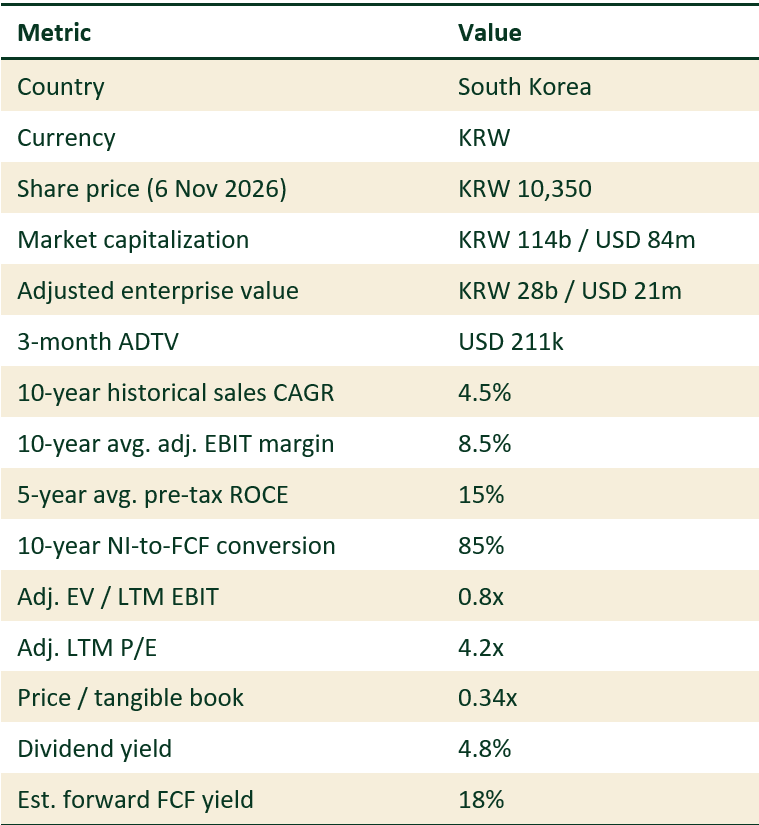
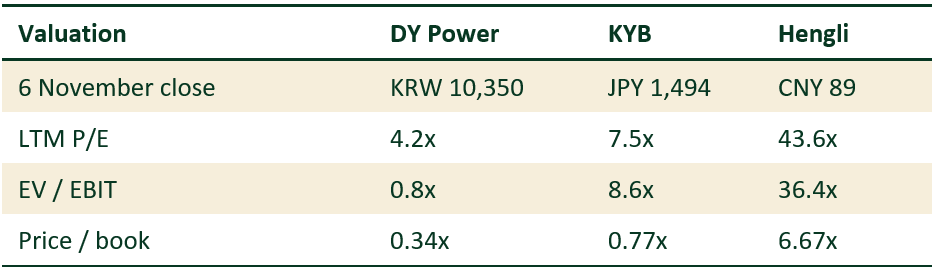
DY Power (Korea ticker 210540) is a precision manufacturer of hydraulic cylinders for heavy machinery (excavators, wheel loaders, forklifts and aerial work platforms). They convert raw steel tubes into an essential component that is not allowed to fail under high pressure or extended use. In exchange for being a reliable OEM supplier, it earns a solid 15% return on capital employed, an 8% EBIT margin and converts most of its net income into free cash flow. In most countries that type of value-added precision manufacturing business would trade at, say, 1x EV-to-capital employed (7x EV/EBIT), but in Korea you can buy it at 0.13x EV/CE, 0.8x EV/EBIT, 4.2x P/E, 0.34x P/B and an 18% normalized equity free cash flow yield. DY Power’s two key public competitors in Japan and China currently trade at 9x and 36x EV/EBIT, respectively.
The USD 200k ADTV limits institutional investor focus on the business, which makes me excited to own this quality business – that also pays a 5% dividend yield – while waiting for a re-rating due to Value-Up programs or other catalysts.
I am a shareholder and DY Power is currently an average size position (3%) in my diversified small cap value portfolio.
Snapshot
Business and competitive position
DY Power was separated from the former Dongyang Mechatronics hydraulic-equipment division in December 2014 and separately listed in January 2015. The company makes hydraulic cylinders that turn fluid pressure into movement in excavators, aerial work platforms, forklifts and other mobile equipment. Factories in Korea, China and India serve customers including Caterpillar, Hitachi, JCB, Volvo, JLG and Doosan Bobcat, directly and through related distributors.
Product examples:
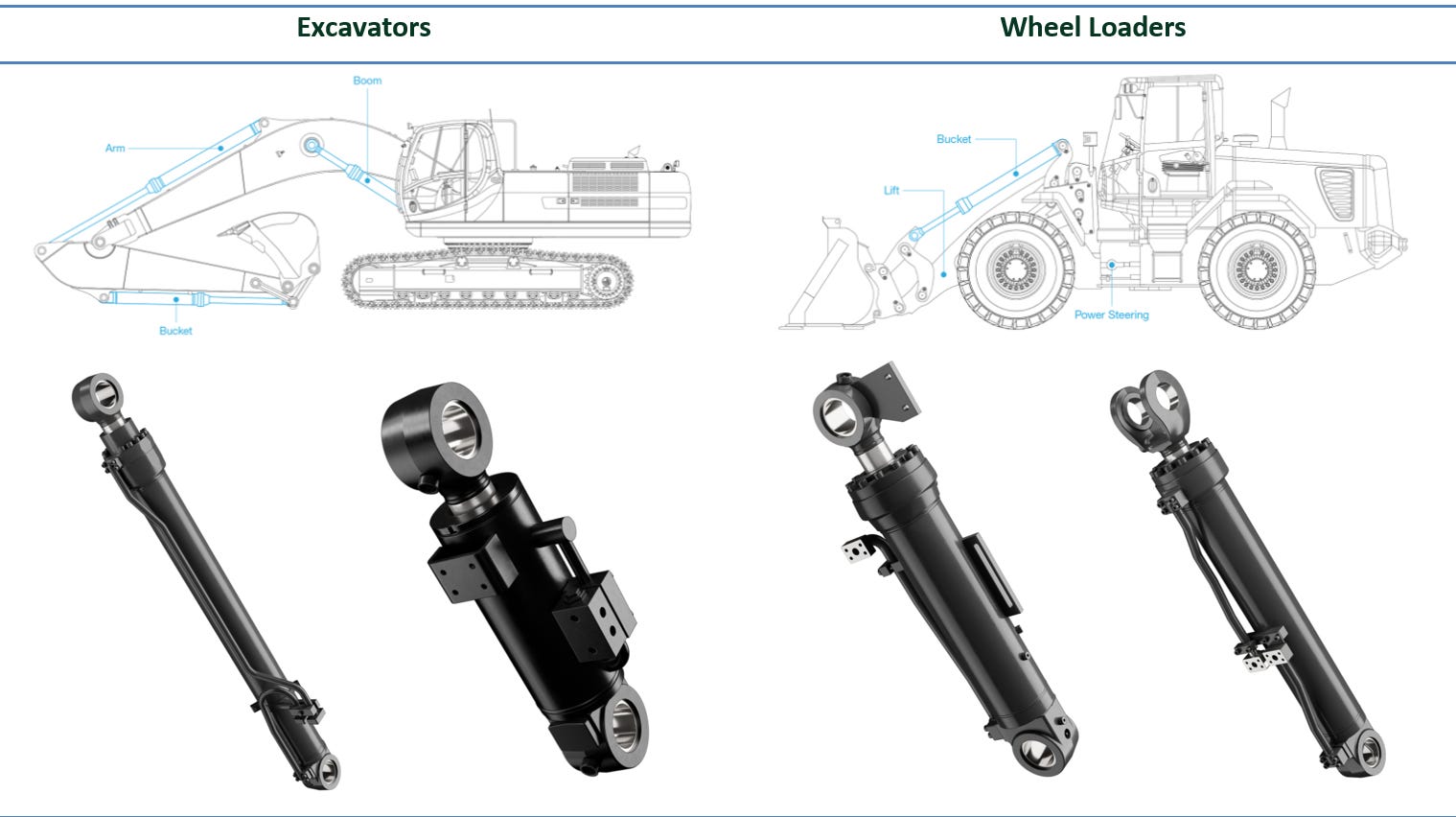
Cylinder failure can immobilize an expensive machine. Precision machining, welding, seals, contamination control and durability testing are important to OEMs. Model qualification and dependable delivery support customer continuity, but large OEMs retain purchasing power and can qualify alternatives or maintain in-house manufacturing. The competitive advantage rests in engineering and manufacturing execution.
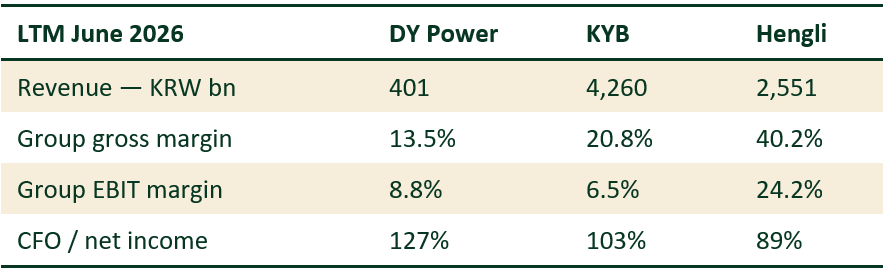
KYB Corporation (“KYB”; Tokyo ticker 7242) and Jiangsu Hengli Hydraulic Co. (“Hengli”; Shanghai ticker 601100) are two publicly traded competitors (although DY Power is a pure-play hydraulic cylinder business whereas KYB has a sizeable automative business and Hengli also manufactures pumps and valves).
Long-term financial development
Sales are somewhat cyclical but have grown at a 4-5% CAGR over the last 10 years. Gross and EBIT margins are defendable and relatively stable for a precision manufacturing subcontractor at ~14% gross and ~8% EBIT:

Operating capital employed grew at a 3% CAGR over the same 10-year period and pre-tax ROCE is a solid 15%. In my view that strikes a good balance between being a value-creating business and also not over-earning to entice OEM customers to backwards integrate and bring cylinder manufacturing in-house:

H1 2026 sales rose 9% and EBIT 27%.
Cash generation and quality
Annual cash flow conversion is uneven due to working-capital swings but the 10-year cumulative net income-to-FCF conversion is a solid 85% and the current rolling 5-year conversion is 110%:

Corporate governance and related parties
The parent company DY Corporation owns 38%, giving it substantial influence over investment, lending and distributions at DY Power. As a positive sign, DY Power’s annual dividend was recently increased from KRW 350 to KRW 500 per share (a 4.8% yield at the current price), although that is still a paltry 22% of FY2025 adjusted EPS.
DY Corporation (the parent) filed a Corporate Value-Up plan on 27 April 2026 (under Korea’s new governance reforms) but DY Power itself has not yet filed a plan.
There are commercial and financial links between DY Power and the DY Corporation parent group:
DY America is co-owned (33% by DY Power and 67% by the DY Corporation group) and distributes DY Power’s products in the US and Mexico. It is also building up hydraulic manufacturing in Mexico. 24% of DY Power’s H1-26 sales went through DY America.
DY Japan is 100% owned by the parent and distributes DY Power’s products in Japan. 16% of DY Power’s H1-26 sales went through DY Japan.
DY Corporation has borrowed KRW 5 bn from DY Power (equivalent to 1.5% of DY Power’s book equity)
DY America has borrowed KRW 23 bn from DY Power (equivalent to 7% of DY Power’s book equity)
On 30 June 2026, trade receivables from DY America were KRW 36 bn (124 days of sales, slightly above the group average of 101 days) and trade receivables from DY Japan were KRW 18 bn (94 days of sales)
Transfer pricing, collections and financing terms determine where economic value accrues between the parent and the subsidiary. I have not found any evidence of minority shareholder abuse, and the new (July 2025) article 382-3 in the Korean Commercial Act also now expressly requires directors to act faithfully for the company and its shareholders, protect shareholders’ collective interests and treat shareholders fairly. This should reduce the risk (in all Korean companies) of undue value-transfers from minority shareholders to a controlling parent company.
Valuation
My adjusted enterprise value is KRW 28bn, equivalent to 0.8x adjusted LTM EBIT. The calculation gives only 70% credit to net cash assets, allowing for the possibility that surplus capital remains retained. The 4.2x adjusted P/E incorporates warranty and currency adjustments to earnings (reported LTM P/E is lower at 3.6x).

Estimated forward free cash flow of KRW 20.6bn represents an 18% equity yield. This estimate assumes 3% sales growth, approximately stable operating margins and reinvestment in fixed assets and working capital. It is below recent LTM cash generation and below the 5-year historical average:

Peer comparison
DY Power earns a higher EBIT margin than the KYB group (whose closer Hydraulic Components segment earns approximately 4.7%). However, roughly 70% of KYB sales are automotive. Hengli has a broader offering and higher profitability: cylinders represented approximately 48% of FY2025 sales and pumps and valves 40%.
Although a direct valuation comparison is of limited use due to different product mix, DY Power is markedly cheaper than both KYB and Hengli:
Base Case Return Potential
I assume modest 3% through-cycle sales growth and an 8.5% EBIT margin (in line with both LTM actual and 10-year average). I assume that the current Korean governance reforms over time result in a slightly better capital allocation at DY Power (~60% of net Income used for dividends and buybacks; up from 20-25% currently) and that it gets valued at 4x EV/EBITA (~9x P/NOPAT). If it takes 3-5 years to achieve that, I estimate a 31%-45% IRR (incl. dividends) from the current KRW 10,350 share price:

Key Risks
OEM production cuts, steel costs and pricing pressure could impact margins cyclically and/or secularly.
Related-party loans, extended distributor collection terms and Mexican expansion could absorb capital without adequate minority returns.
Cash retention or lack of Value-Up programs could prolong the valuation discount.
Sources
Historical financial series: Koyfin and author calculations based on Korean DART filings.
Disclaimer
This publication is for information and discussion only. It is not investment advice or a recommendation to buy, hold or sell any security and does not consider your financial circumstances. Do your own due diligence and seek independent professional advice where appropriate.
I may own securities discussed and may buy, add to, reduce or sell positions at any time without notifying readers, subject to applicable disclosure requirements. My interests may differ from yours. Opinions and estimates may change without notice; I do not undertake to provide trading updates.
Information is believed reliable but may contain errors or omissions. Forecasts are uncertain, past performance does not predict future returns, and investments can lose some or all of their value. Small and micro-cap shares may be illiquid, and currency movements can affect returns.