

Executive summary
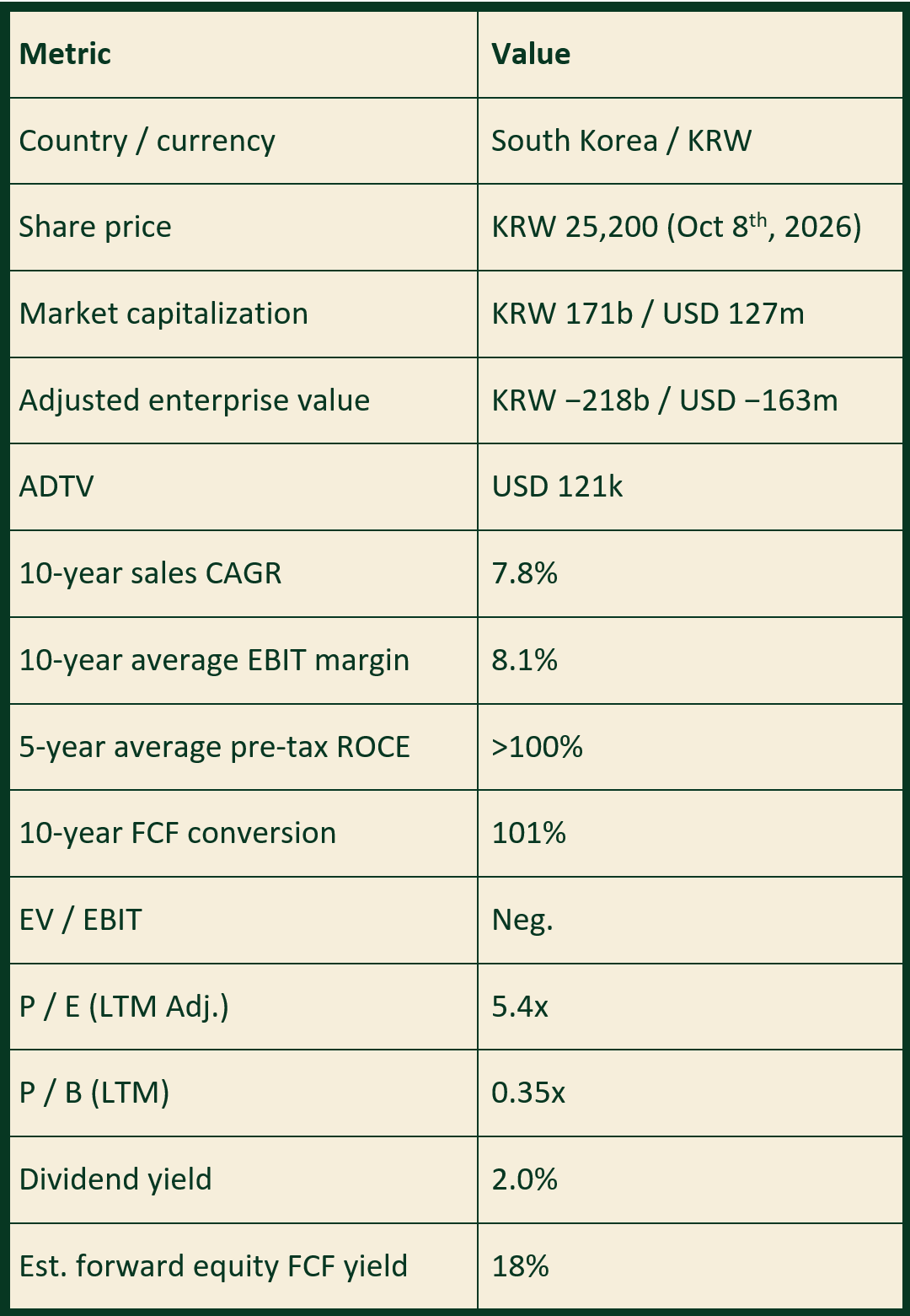
Kukbo’s current market valuation appears to overly penalize its solid, asset-light, operating business combined with an unusually large securities portfolio. At KRW 25k per share, Kukbo’s market cap of KRW 171b compares to net surplus assets of KRW 555b (estimated mark-to-market as of October 6th) and an operating business generating KRW 40b in LTM EBIT. So even if the financial asset portfolio went to zero, we would own the operating business at 4x EBIT and 5.4x P/E.
Despite the massive and low cash-dividend yielding securities portfolio, I estimate an 18% forward equity free cash flow yield (17% on historical 5-year average FCF) which strikes me as too cheap under almost any plausible scenario.
Kukbo should be a beneficiary of Korea’s increasing focus on low stock market valuations and the “Corporate Value-Up” program. Kukbo could face additional pressure over its low 0.35x P/B ratio under the low-PBR disclosure framework and the Korea Exchange November “name-and-shame” list, and it should be eligible for the preferential dividend tax treatment if it starts paying out at least 40% of net profits.
At 40% of adjusted net income, the dividend yield would increase from 2.0% to 7.5%.
We are shareholders in the company.
Snapshot
Business and competitive position
Founded in 1983, Kukbo designs and builds interiors for offices, commercial premises, hotels and institutional buildings. It coordinates procurement, subcontractors and delivery rather than owning a large manufacturing base. Most contracts run for about a year, with revenue recognized as work progresses.
Track record, financial capacity and reliable execution help it qualify for larger projects. Kukbo reports leading Korea’s interior construction capacity ranking since 2012, although that ranking measures tender capacity rather than market share. Competitive bidding and clients’ control over variations and payment limit pricing power. Korea supplied 86% of FY2025 revenue and 90% in the first half of 2026; furniture and materials activities are small.
General Situations & Co. recently published on the company:

I recommend reading that for more detailed background on the business. For my purposes, I feel comfortable that the operating business is likely to continue to grow its intrinsic value and generate attractive cash flow over the medium- to long-term, which is important given the uncertain time to value realization.
Long term financial development
Sales rose from KRW 67bn in 2005 to KRW 439bn in 2025, more than sixfold over twenty years (10% CAGR). EBIT margins averaged about 7% across FY2005–2025 and 8% in the last ten years, reflecting improved profitability as well as expansion:

Recent demand is less reassuring. First-half 2026 revenue fell 6% and operating profit fell 20%. New contract value declined 12%, while closing backlog was 32% below the prior-year half-year level.
The company operates with little or negative operating capital employed due to customer funding and supplier credit support, while fixed-asset requirements are modest.
Cash generation and quality
As a result of the low/negative operating capital needs, Kukbo has generally converted more than 100% of its net income to free cash flow (105% in the last five years):

Capital allocation and governance
The controlling Hwang family held 54% of issued shares on 30 June 2026, leaving outside investors with limited influence over retained capital. Dividends and repurchases totaled KRW 26bn over FY2019–2025, only 14% of cumulative free cash flow. The KRW 500 annual dividend yields 2.0% and is a meager 12% of 5-year average adjusted EPS.
Equity portfolio
On 30 June 2026, investment securities totaled KRW 447bn, approximately 2.6x Kukbo’s market capitalization.
The portfolio includes semiconductor companies, AI infrastructure suppliers and other growth stocks: Nvidia, Broadcom, Micron, SK Hynix, Samsung Electronics, Tesla and Palantir are among the names. Starting with a 2019 cash balance, a series of aggressive equity bets (Tesla represented 76% of the end-2021 portfolio…) – with a major hiccup in 2022 – has grown the portfolio dramatically:

Applying October 6 prices to the disclosed June holdings, and assuming no subsequent trading, gives an indicative portfolio value of approximately KRW 400bn, still representing 2.4x Kukbo’s market cap.
Valuation
We credit 70% of net surplus (financial) assets in adjusted enterprise value, allowing for the possibility that surplus capital remains inside the company at low returns. Using this definition, EV turned negative in 2023:

The historical multiples (including the current LTM P/E of 5.4x) do not include any gains or losses on the securities portfolio.
My estimated forward free cash flow is KRW 30.5bn, equivalent to 18% of market capitalization. That compares with the five-year historical FCF average of KRW 28.9bn and does not include any securities gains or losses.
Base Case Return Potential
I assume it takes five years for the tax & governance reforms and the Corporate Value-Up to result in material positive change at the company (increasing annual dividends and potential one-off distributions from the securities portfolio). At that point, I assume the operating business is valued at 2-6x EV/EBIT (flat EBIT from today) plus cumulative operating free cash flow, and the net surplus financial assets at 40-80% of today’s value (no future return assumption). That results in the following range of annualized returns:

I view that as a very attractive risk/reward proposition.
Key Risks
Correlated technology holdings could materially erode financial assets
Family control and continued capital retention could leave the valuation discount in place for longer than my assumed five years
Falling orders or weaker project execution could reduce revenue, margins and cash generation in the contracting business.
Sources
Historical financial series: Koyfin and author calculations based on official Korean DART filings. Portfolio balances and operating developments refer to June 2026 consolidated disclosures; forecast figures are author estimates.
Disclaimer
This publication is for information and discussion only. It is not investment advice or a recommendation to buy, hold or sell any security and does not consider your financial circumstances. Do your own due diligence and seek independent professional advice where appropriate.
I may own securities discussed and may buy, add to, reduce or sell positions at any time without notifying readers, subject to applicable disclosure requirements. My interests may differ from yours. Opinions and estimates may change without notice; I do not undertake to provide trading updates.
Information is believed reliable but may contain errors or omissions. Forecasts are uncertain, past performance does not predict future returns, and investments can lose some or all of their value. Small and micro-cap shares may be illiquid, and currency movements can affect returns.
Owning the operating business at 4x EBIT even with the securities portfolio at zero is a clean way to size the downside. Since that portfolio is bigger than the market cap, how much of it is liquid Korean equities that would fall together in a bad market, and does that change how much credit you give it?