

Executive summary
Nongshim Holdings (“Holdings”) is an opportunity somewhat idiosyncratic to Korea given the prevalence in Korea of companies that have both the operating business and the controlling shareholder listed. That was common in Japan as well, but over the last 10-15 years many listed parent companies have bought out minorities in their listed subsidiaries. I do not assume a buy-out here, but own the parent due to the large implied discount on the operating business.
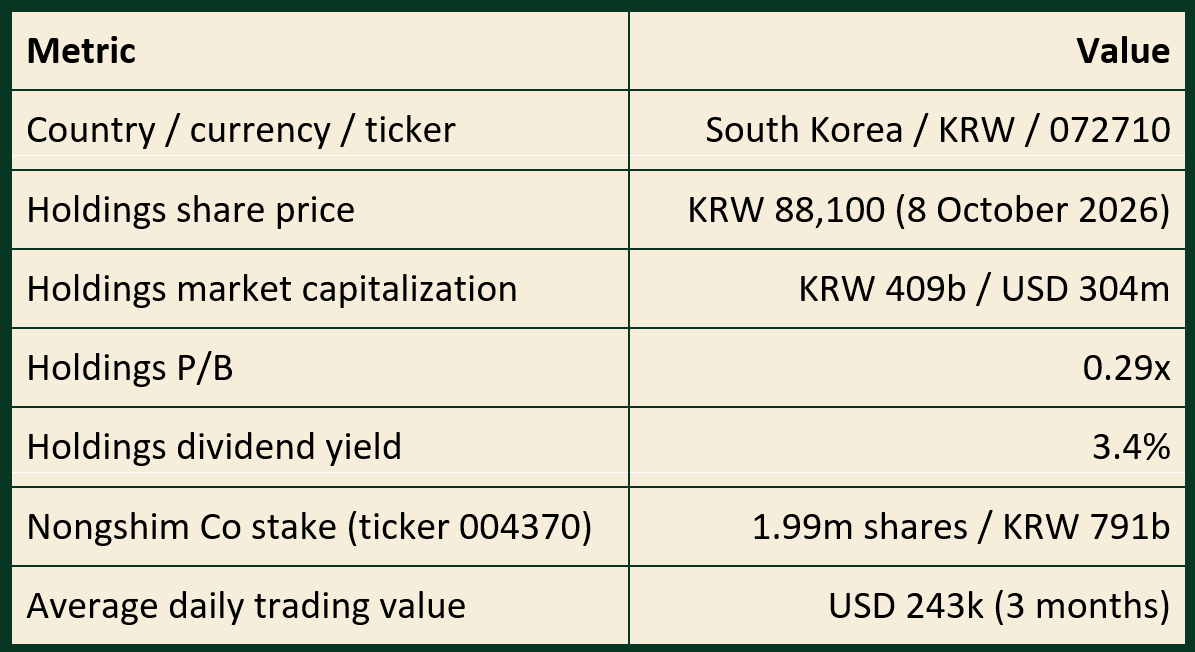
Holdings trades at a 0.29x PBR and its KRW 409b market cap compares to the KRW 791b market value of its Nongshim Co stake. Adding other investment assets, deducting net debt and adding Holdings’ own operating businesses at 5x EBIT, I estimate a 68% implied discount on Holdings’ stake in Nongshim Co. At that discount, Nongshim Co is valued at a negative EV and a 4x LTM adjusted P/E.
I am a shareholder in Nongshim Holdings.
Snapshot
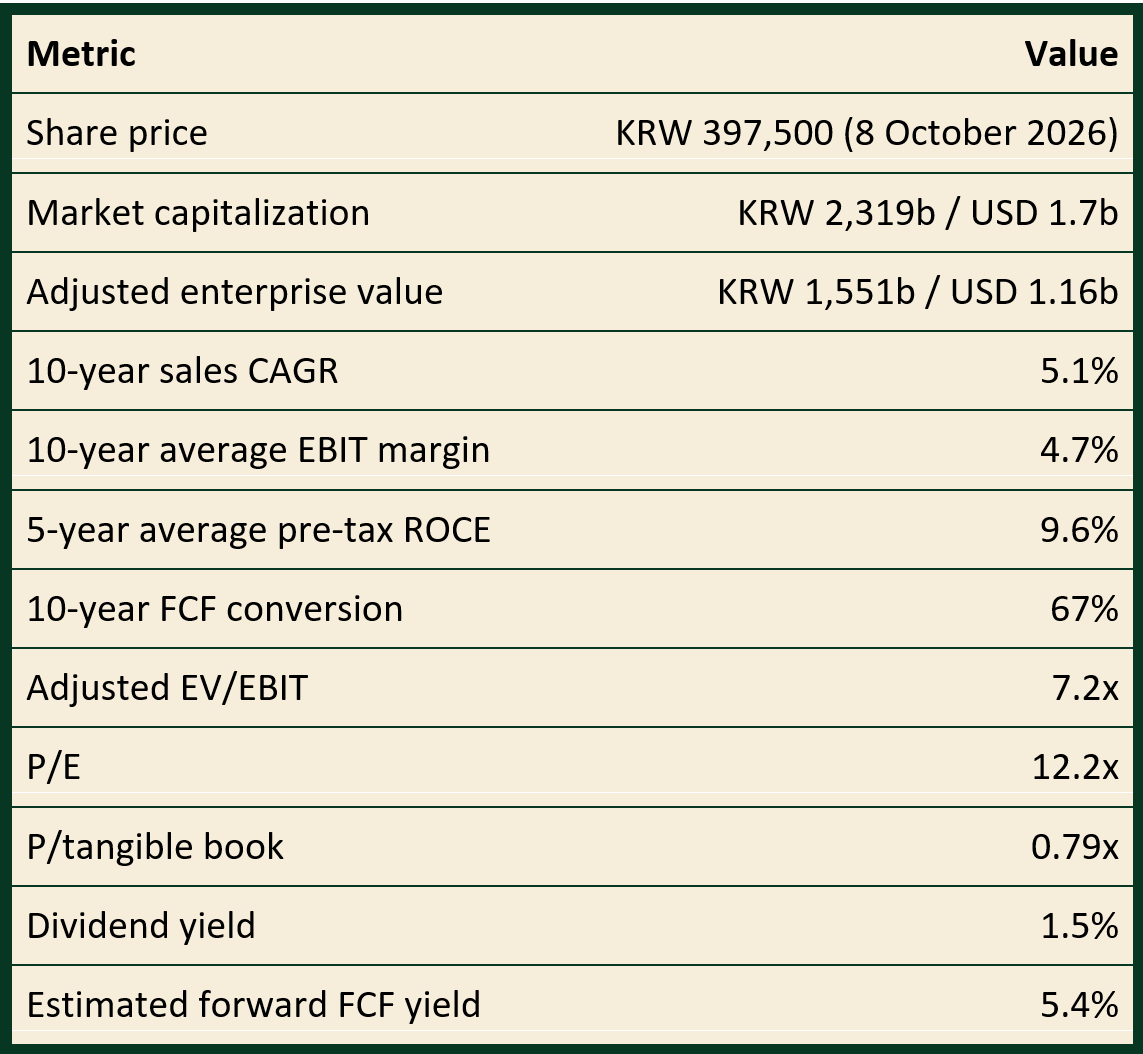
Nongshim Co (Korea ticker 004370) supporting snapshot
Business and competitive position
Holdings owns 34% of Nongshim Co after excluding treasury shares. Nongshim Co is an equity-accounted associate, so its sales and operating profit are absent from Holdings’ consolidated operating totals. Holdings also owns food ingredients and sauces businesses, an engineering contractor and golf courses, plus 32% of listed packaging producer Youlchon Chemical. We need to evaluate the consumer business first, because it accounts for most of the asset value within Holdings.
Nongshim Co and the consumer franchise
Founded in 1965, Nongshim manufactures branded instant noodles, snacks and other packaged food. Shin Ramyun is the flagship; Chapagetti, Neoguri and Ansungtangmyun broaden its appeal across flavours and formats. Shrimp crackers, bottled water and distributed brands add shelf space and sales. Revenue comes from repeated purchases at modest ticket prices. Profit depends on volumes, realized selling prices and product mix, less ingredients, packaging, factory costs, distribution and promotion.
The attraction is the combination of a large established Korean franchise and a brand with growing international reach. Household recognition, retailer relationships and manufacturing scale are difficult to replicate quickly. Local factories and distribution can support wider availability overseas. Nongshim operates six Korean plants, alongside manufacturing in China and the United States. These assets give it scale but also require continuing investment and sufficient utilization.
The Korean market is mature. Nongshim’s reported Nielsen noodle market share was 55% in the first half of 2026, compared with 56% in 2024 and 2025. Its snack share was 33%. World Instant Noodles Association estimates put Korean demand at 4.1 billion servings in 2025, slightly below 2024. Domestic growth therefore depends substantially on price, mix and defending share. There is competition from Samyang, Otoki and Paldo.
Overseas growth offers a different opportunity. Foreign subsidiaries generated 30% of external sales in 2025 and 34% in the first half of 2026. This measure excludes exports booked by the Korean business. The United States is the largest overseas earnings contributor, while China, Japan, Canada, Australia and Europe diversify distribution and consumer demand.
The recent American results are encouraging. US sales were KRW 524bn and EBIT KRW 27bn in 2025. First-half 2026 sales reached KRW 287bn, with EBIT of KRW 32bn, already exceeding the previous full year. Better utilization and mix can produce substantial operating leverage. Europe’s reported growth also partly reflects the move to direct subsidiary distribution.
Global popularity of Korean food helps introduce new consumers, but competitors benefit too. Samyang’s Buldak franchise competes for attention, and Nissin brings established international brands and distribution. Nongshim must turn trial purchases into repeat demand while funding promotion. Sales allowances increased from 10% of gross sales in 2023 to 14% in 2025. The brands are valuable; their economic strength still needs to appear in sustained margins and returns on new capacity.
Management’s July 2026 plan targets 2030 sales of KRW 7.3trn, a 10% operating margin and 61% overseas sales. Reaching the sales target requires roughly 16% annual growth, well above the historical record. The plan identifies an opportunity and management ambition but is not something we count on.
Long term financial development
Nongshim Co’s sales rose from KRW 1.64trn in 2005 to KRW 3.51trn in 2025, approximately doubling over twenty years. EBIT rose from KRW 145bn to KRW 184bn over the same period. Growth in the top line therefore translated into much slower growth in operating profit. The EBIT margin declined from 8.8% to 5.2%; overseas expansion and brand recognition have not yet restored the profitability of the earlier business.

Operating capital employed rose from approximately KRW 900bn in 2008 to KRW 1.8tn currently as the plant footprint expanded both in Korea and internationally. Pre-tax ROCE has recently recovered to the long-run average around 12% after a period of high investment from 2018 to 2024:

The Noksan export-only factory illustrates the next test. Its disclosed budget increased to KRW 204bn, with scheduled completion moved to 30 October 2026. New capacity can relieve constraints and improve export economics. It can also depress returns during ramp-up if demand grows more slowly than capacity.
The other Holdings assets
Taekyung and its American subsidiary supply seasonings, processed food ingredients and traded agricultural commodities. Combined 2025 sales were KRW 582bn and EBIT KRW 23bn. Commodity trading represented about 43% of sales, making revenue a poor shorthand for higher-value manufacturing. First-half 2026 sales grew 10%, while net profit increased only modestly. The link to Nongshim supports customer relationships but concentrates demand within the wider group.
Sewoo adds soy sauce, fermented pastes and dried or seasoned ingredients. Holdings acquired the company in August 2025 for approximately KRW 100bn. Sewoo’s full-year 2025 sales were KRW 139bn and EBIT KRW 15bn; first-half 2026 net profit was KRW 9bn. It is a meaningful earnings addition, although the sellers’ family connections make price and conflict safeguards important. The KRW 45bn bargain-purchase gain recognized by Holdings suggests the purchase price was reasonable.
Nongshim Engineering designs and builds food and industrial facilities. Its projects are uneven: a KRW 6.5bn operating loss in 2025 followed a profit in 2024. First-half 2026 sales rebounded, but EBIT was only KRW 0.3bn. Nongshim Development owns the Ildong Lakes membership golf course and Rock Garden public course. It earned KRW 2.9bn EBIT in 2025. Land has potential value, but golf-course deposits and restrictions on monetizing operating property complicate an asset-only valuation.
Youlchon manufactures flexible packaging and films, alongside electronic materials including battery-pouch products. Its packaging business reinforces exposure to the Nongshim group; the electronic-materials business adds different competitive and capital-spending risks. The stake is worth KRW 123bn at the current market price.
Cash generation and quality
Nongshim Co’s 10-year cumulative free cash flow was KRW 774bn, or 67% of cumulative adjusted net income. Rolling 5-year FCF conversion has recently recovered following a period of large factory CapEx spend:

Capital allocation and governance
Holdings’ latest KRW 3,000 dividend offers a 3.4% yield, compared with 1.5% on Nongshim Co’s KRW 6,000 dividend. Holdings’ policy is to return at least 50% of standalone operating profit excluding non-recurring items, capped by dividend income. The 2026 governance report commits to maintaining it for at least three further years.
Control is concentrated. Shin Dong-won held 43% of Holdings and the disclosed controlling group 67% at June 2026. The four-member board comprised three executives and one independent director. Substantial family ownership can encourage a long horizon, but minority shareholders have limited power to redirect investment or force realization of the Nongshim stake. The governance report describes investor engagement but no additional capital-return measure beyond dividends.
The Sewoo acquisition demonstrates the allocation trade-off. Parent cash flow did not finance the purchase and dividend together; deposit withdrawals and borrowing filled the gap. Holdings has a KRW 50bn parent bond maturing in November 2028, while parent cash and deposits were only KRW 7bn at June 2026. A large quoted equity portfolio therefore coexists with a parent that depends on subsidiary distributions. Higher payouts, debt repayment, disciplined acquisitions or a credible buyback policy would make the discount more valuable to outside owners.
Valuation and the use of financial assets
At KRW 397,500, Nongshim Co has a market capitalization of KRW 2.32trn. Crediting 70% of net cash and financial assets under our standard valuation convention gives adjusted EV of KRW 1.55trn and 7.2x EV/EBIT. LTM P/E is 12.2x. The estimated forward FCF yield is 5.4%, compared with a ten-year historical FCF yield of roughly 3.3%

Owning Nongshim Co through Nongshim Holdings
I like the noodle business but don’t view its shares as materially undervalued. Holdings offers a separate entry price. Its market capitalization is KRW 409bn, while its Nongshim stake is worth KRW 791bn. Even assigning zero net value to everything else implies a 48% discount to the stake. To make the comparison more informative, we need a reasonable value for the other assets after their liabilities.
We value Holdings’ consolidated own-operating businesses at 3–7x their KRW 37b LTM EBIT, add the Youlchon stake and KRW 19b of other financial investments, and deduct KRW 174bn of consolidated net financial debt.
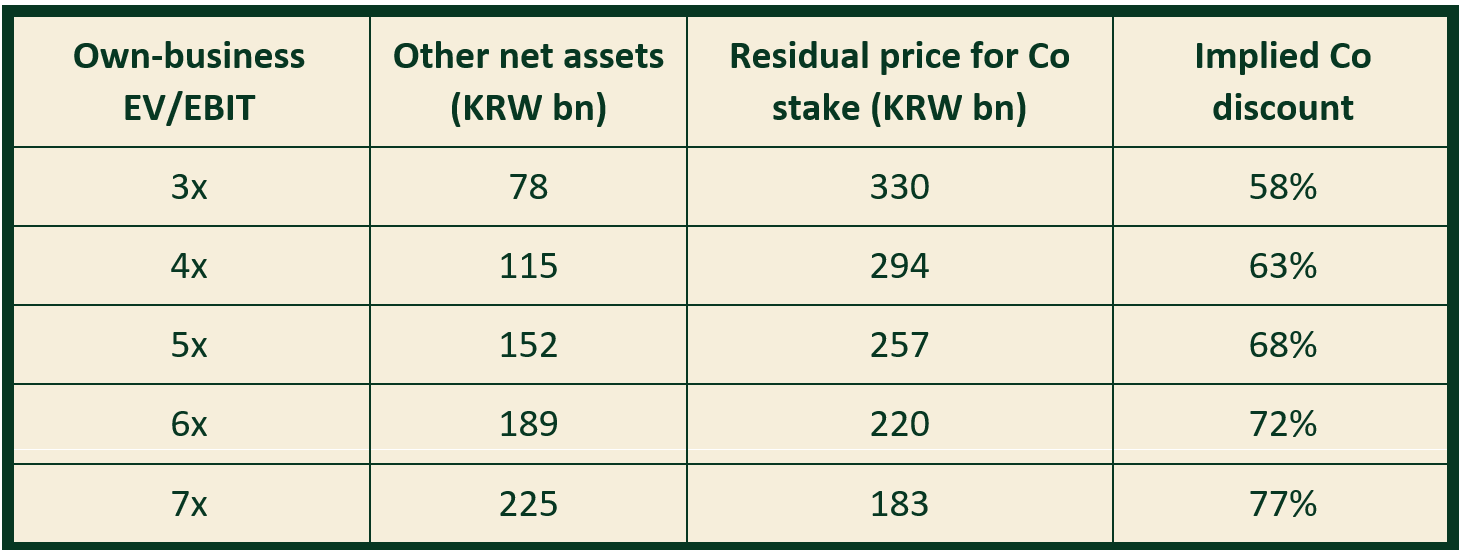
The implied discount is 58–77%, with my mid-point at 68%. Holdings was created in a 2003 demerger and since then it has always traded at a significant discount to NAV (between 11% and 73%) and with a large implied discount on its Nongshim Co stake (between 12% and 102%):

So what is different today that could make Holdings’ share price outperform from here? In my view, the focus on low PBR multiples and Corporate Value-Up programs in Korea significantly increases the likelihood of the Nongshim controlling shareholders focusing more on increasing shareholder value in Holdings and thereby closing the implied discount over time. Holdings also currently trades close to a historical low PBR:

Base Case Return Potential
I assume that Nongshim Co grows EBIT from KRW 184bn in 2025 to 254bn in 2028 (11% CAGR) in line with KB Securities research from March 2026. This is clearly not on track to achieve the company’s medium term plan of 730bn by 2030 but feels reasonable. At EV/EBIT 9x (crediting only 70% of net cash) – compared to a 20-year median of 11x – that is an EV of KRW 2,286bn and a market cap of 3,233bn (KRW 554k per share)
I further assume the ongoing Korean corporate governance and Value-Up work forces Holdings to take actions towards closing the valuation discount. I assume increasing pressure for better capital allocation contributes to the implied stake discount narrowing from 68% to 40%. That implies a Holdings market cap of KRW 813bn in three years and an annualized return of approximately 26% from today.
This is obviously not an exact science, but I view the risk/reward profile as quite favorable.
Key Risks
Nongshim’s international expansion may consume capital faster than it creates earnings; domestic competition and promotion can offset overseas growth.
Family control and limited minority influence may leave the discount in place. Current dividend policies do not require a stake sale or distribution of the group’s surplus assets.
Disclaimer
This publication is for information and discussion only. It is not investment advice or a recommendation to buy, hold or sell any security and does not consider your financial circumstances. Do your own due diligence and seek independent professional advice where appropriate.
I may own securities discussed and may buy, add to, reduce or sell positions at any time without notifying readers, subject to applicable disclosure requirements. My interests may differ from yours. Opinions and estimates may change without notice; I do not undertake to provide trading updates.
Information is believed reliable but may contain errors or omissions. Forecasts are uncertain, past performance does not predict future returns, and investments can lose some or all of their value. Small and micro-cap shares may be illiquid, and currency movements can affect returns.
Buying the parent for the noodle stake at a 68% look-through discount makes sense to me, especially with the 0.29x PBR. Given the family control risk you flagged, what would you need to see from Holdings, a bigger payout or a stake sale, before you'd say the discount has started to close?