

Executive summary
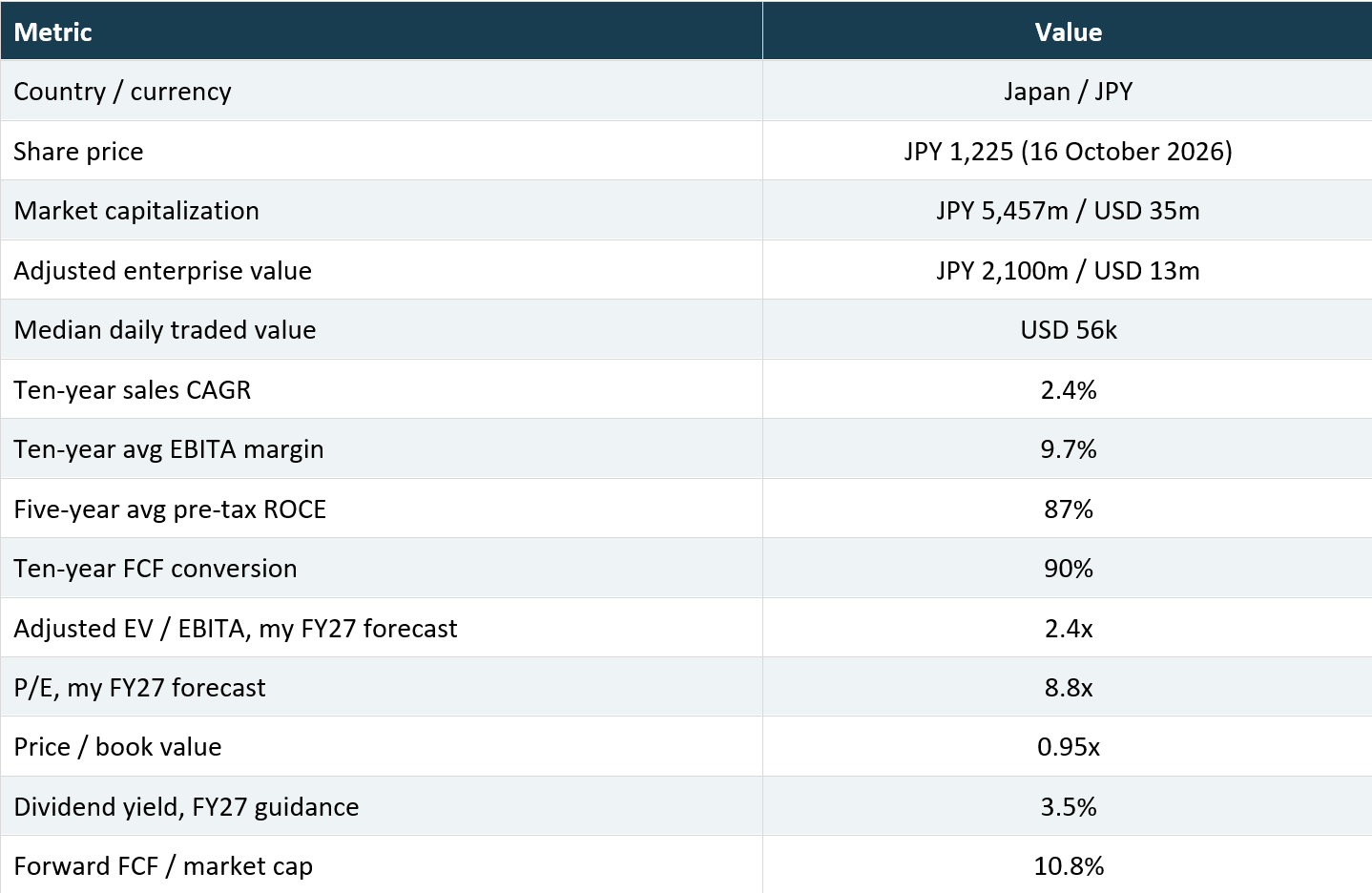
PRAP is a Japanese communications consultancy with a profitable domestic franchise, limited capital requirements and substantial financial assets. Five-year average ROCE is 87%, and ten-year free cash flow conversion is 90%. However, a large cash balance depresses returns on equity, while digital and overseas operations contribute relatively little profit so far.
My FY2027 forecast assumes 8% revenue growth and a flat EBITA margin, substantially below management’s (outdated) medium-term target. Even on these lower assumptions, the shares trade at 8.8x P/E and 2.4x EV/EBITA (after applying my usual 30% discount to net cash). The dividend yield is 3.5%.
Edelman’s agreed purchase of WPP’s approximately 21% voting stake provides a potential catalyst. Commercial cooperation could bring additional business, but my main interest is whether a new strategic shareholder can improve capital allocation. WPP previously sought a larger distribution (in 2019) and was opposed by the board, but the climate for capital allocation change is quite different in Japan now.
My base case assumes higher dividends, sustained buybacks and a revaluation to 5x EV/EBITA over three to five years. That combination would result in a 21-28% IRR. With less material governance and capital allocation change, the forward FCF yield of 11% is perhaps a more realistic target for annual returns.
I am a shareholder in PRAP and it is currently 6% of my global small-cap value portfolio.
Snapshot
Business and competitive position
PRAP helps companies manage relationships with customers, the media, employees and other stakeholders. Its work includes communications strategy, product launches, crisis advice, executive media training, digital campaigns and content. Retainers provide continuing access to advisers; projects and events add less predictable revenue.
The domestic communications business is the main source of profit. In FY2026 it generated external sales of JPY 5,098m (66% of group total) and JPY 682m of segment operating profit (92% of total; 13.2% margin) . Digital Solutions contributed JPY 788m of external sales but approximately broke even. China and SEA contributed JPY 1,874m of external sales and JPY 36m of operating profit.
Japanese customers accounted for 79% of revenue, China 14% and other overseas markets 7%. No customer exceeded 10%. Reputation, specialist knowledge and longstanding relationships help win repeat work, particularly in healthcare, technology and sensitive corporate matters.
PRAP competes with listed Japanese agencies, international networks, boutiques and clients’ own teams. Routine execution faces pressure from self-service tools and AI. Crisis judgement and trusted advice should be harder to automate, but they depend on retaining capable people. PR Automation adds software subscription revenues and is growing strongly from a small base.
Long term financial development
Over the last 24 years (August FYE), sales grew at a CAGR of 5% and EBITA at 6% (before goodwill amortization). Mostly organic growth except smaller acquisitions in 2009, 2021 and 2025. The pandemic produced a sharp downturn in FY2020. The company maintains an outdated medium-term plan forecast for FY2027 that I (and the market I believe) view as too optimistic. The following chart reflects my own (lower) forecast. At the start of FY2022, PRAP adopted Japan’s new revenue-recognition standard. Where it arranged advertising or other third-party services as an agent, it stopped recording the customer’s full bill as revenue and instead recorded its net fee after supplier costs. Both revenue and cost of sales fell but gross profit and EBIT were unchanged. In the following chart, I use the company’s lower restated 2022 sales and have estimated (lower) 2021 sales for the new accounting rules.

PRAP has limited physical capital requirements. My operating capital measure (net working capital plus net property, plant, equipment and software), increased from about JPY 275m in FY2003 to JPY 1,063m in FY2026 (6% CAGR). Pre-tax ROCE was 75% in FY2026, below earlier levels but still attractive. The recent five-year average ROCE was 87%. FY2026 ROE was only 9% however, illustrating the impact of holding substantial low-yielding financial assets.

My FY2027 forecast and management’s unchanged target
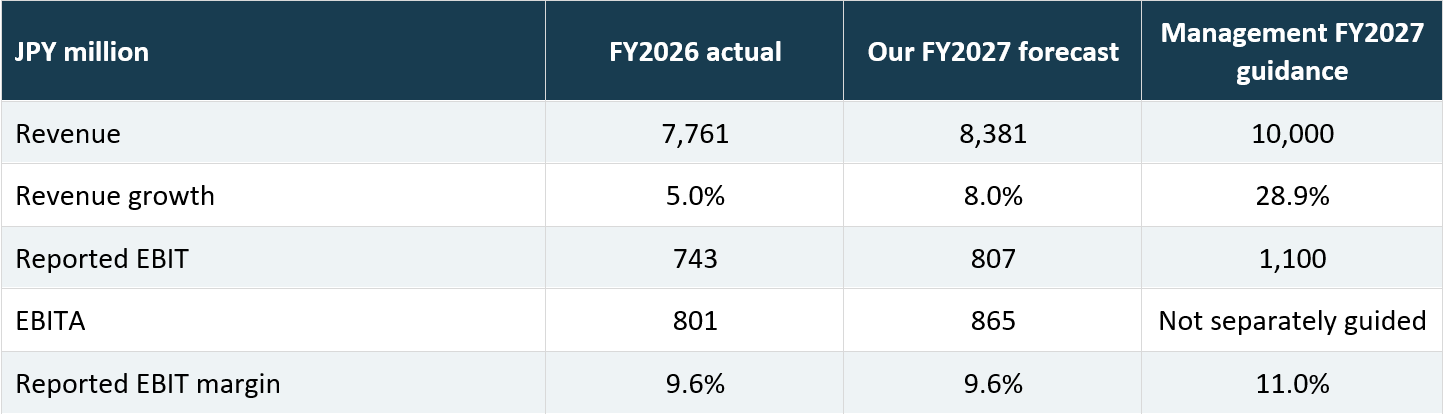
The company’s recent FY2027 forecast of JPY 10bn sales and JPY 1.1bn operating-profit exactly repeat the targets in its October 2024 medium-term plan. My view is that retaining the old plan may be driven more by the internal politics of withdrawing an announced ambition than by management’s best estimate of the most likely outcome. My FY2027 forecast assumes 8% revenue growth and a flat 10.3% EBITA margin, which results in a reported EBIT 27% below management’s guidance. However, the current valuation does not require management’s higher forecast to be achieved (see valuation section below).
Cash generation and quality
PRAP has strong conversion of earnings into free cash flow, with a rolling 5-year conversion ~90%. Recent capitalized investment is increasingly software related.

Capital allocation, governance and the 2019 AGM dispute
PRAP held JPY 4,629m of cash and deposits and JPY 293m of investment securities in August 2026 – a combined 85% of market cap (after deducting minority interests). Dividends have been largely flat since 2019 and the current guidance is for JPY 43 per share (3.5% yield) which is a 33% payout ratio (on adjusted earnings) and means that the company continues to build up excess cash.
The widow and heirs of PRAP’s founder Hisashi Yajima (who passed in 2012) own 37% of the company. In 2002 (before the 2005 IPO), WPP Holdings acquired 28% of PRAP from the founder (later diluted to 21%) and also entered into a business cooperation agreement with WPP’s Ogilvy PR. It is not clear what benefits the partnership have brought to PRAP, but at some point the governance cooperation broke down. At the 2019 AGM, WPP proposed a JPY 250 per share dividend (27% of the cash balance and 17% of the market cap at the time) arguing that PRAP had accumulated excessive internal reserves without a sufficiently concrete, achievable plan for their use. The board (except for WPP’s director) opposed the shareholder proposal and it was voted down.
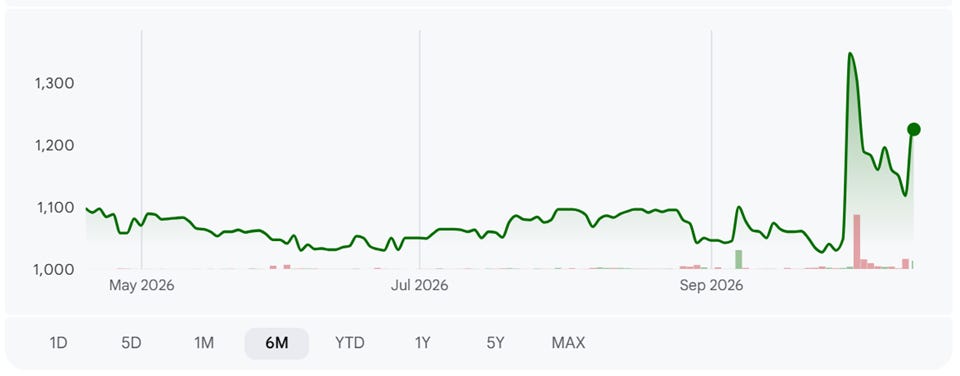
A couple of weeks ago (October 1st) PRAP announced that Daniel J. Edelman, Inc. will acquire WPP’s entire holding for JPY 1,359 per share (a 30% premium to the JPY 1,048 closing price). Even at that premium, Edelman is only paying 10x P/E and 3x EV/EBIT, highlighting the governance discount implied by the market. After some volatility, the share price closed on October 16th at JPY 1,225:
Edelman’s international client base could bring Japanese mandates, while PRAP’s Japanese clients could use its overseas network. Shared expertise in crisis advice, data and AI may improve service breadth. But Edelman already operates in Japan, and WPP previously supplied a global affiliation, so we will have to wait and see what additional benefits Edelman brings to PRAP and us as shareholders.
Valuation and the use of financial assets
I normally only credit 70% of net cash assets in EV, reflecting the risk that surplus capital stays on the balance sheet. On this basis, PRAP’s adjusted EV is JPY 2,100, against market capitalization of JPY 5,457m. That puts the operating business at 2.6x FY2026 EBITA and 2.4x my FY2027 forecast. The equity trades at 9.5x my FY2026 normalized net income and 8.8x my FY2027 normalized forecast:

The gap between EV/EBIT and P/E is central to the thesis. As shareholders we own an inexpensive operating business, but much of the purchase price remains tied up in cash. If those assets earn little and are not returned, the very low EV multiple will not translate automatically into a high equity return. Cash accessibility and future allocation are therefore as important as the arithmetic discount.
My estimated forward free cash flow (with normalized CapEx and NWC) is approximately JPY 590m, or 10.8% of market capitalization:

Peer comparison
Kyodo and Material are the closest listed operating references. Enjin is smaller and recent earnings have declined. A PR segment comparison is more informative than consolidated margins alone (see rightmost column). PRAP’s domestic communications margin was 13.2%, compared with 18.4% for Kyodo’s PR business, 21.1% for Material’s PR consulting and 19.9% for Enjin’s PR consulting. Differing central-cost and goodwill allocations prevent a precise efficiency ranking, but PRAP’s domestic margin seems to have room for improvement.

For valuation, the following table applies one common convention to all four: full credit for cash and 50% credit for other financial investments, with debt, leases and minority book equity added. This differs from the 70% net-cash policy used in my headline valuation above but puts all peers on an equal footing. Adjusted earnings add back goodwill amortization and remove identified exceptional items, retaining recurring costs.

P/E multiples are similar for the first three, but PRAP is by far the least expensive operating business on an EV basis given its substantial cash balance.
Base Case Return Potential
I assume that Edelman as a new 21% shareholder will tread carefully initially, but over time will not accept that PRAP continues to hold so much excess cash. My base case assumption is that it will successfully get PRAP to at least double its dividends to a 66% payout ratio and allocate an equal amount to share buybacks. If that started from the next AGM (November 2027), PRAP’s net financial assets would still only decline from JPY 4.6 billion to JPY 3.7 billion over five years given its strong cash flow generation. For my purposes I assume that a PRAP with slightly better capital allocation gets valued at 5x EV/EBITA (~13x P/NOPAT). If it takes 3-5 years to achieve that, I estimate a 21%-29% IRR (incl. dividends) from the current JPY 1,225 share price:

Given the rock-solid balance sheet and attractive operating business, waiting for improved capital allocation strikes me as a solid risk/reward proposition.
Key Risks
Growth could disappoint even our reduced forecast. Management’s unchanged MTP target leaves the market exposed to a larger guidance reduction.
Competitive pitches and AI-assisted execution could limit fee growth and pressure utilization.
Cash may remain underused or fund disappointing acquisitions.
Edelman may provide limited incremental business, or referrals may carry costs and client conflicts that reduce the benefit to PRAP’s minority shareholders.
Disclaimer
This publication is for information and discussion only. It is not investment advice or a recommendation to buy, hold or sell any security and does not consider your financial circumstances. Do your own due diligence and seek independent professional advice where appropriate.
I may own securities discussed and may buy, add to, reduce or sell positions at any time without notifying readers, subject to applicable disclosure requirements. My interests may differ from yours. Opinions and estimates may change without notice; I do not undertake to provide trading updates.
Information is believed reliable but may contain errors or omissions. Forecasts are uncertain, past performance does not predict future returns, and investments can lose some or all of their value. Small and micro-cap shares may be illiquid, and currency movements can affect returns.
The EV versus P/E gap framing is the cleanest explanation I've seen of why a cheap operating business can still disappoint equity holders. WPP already tried and failed to force payouts in 2019 against the family's 37%, so what do you think Edelman can do differently beyond riding the broader governance shift in Japan?